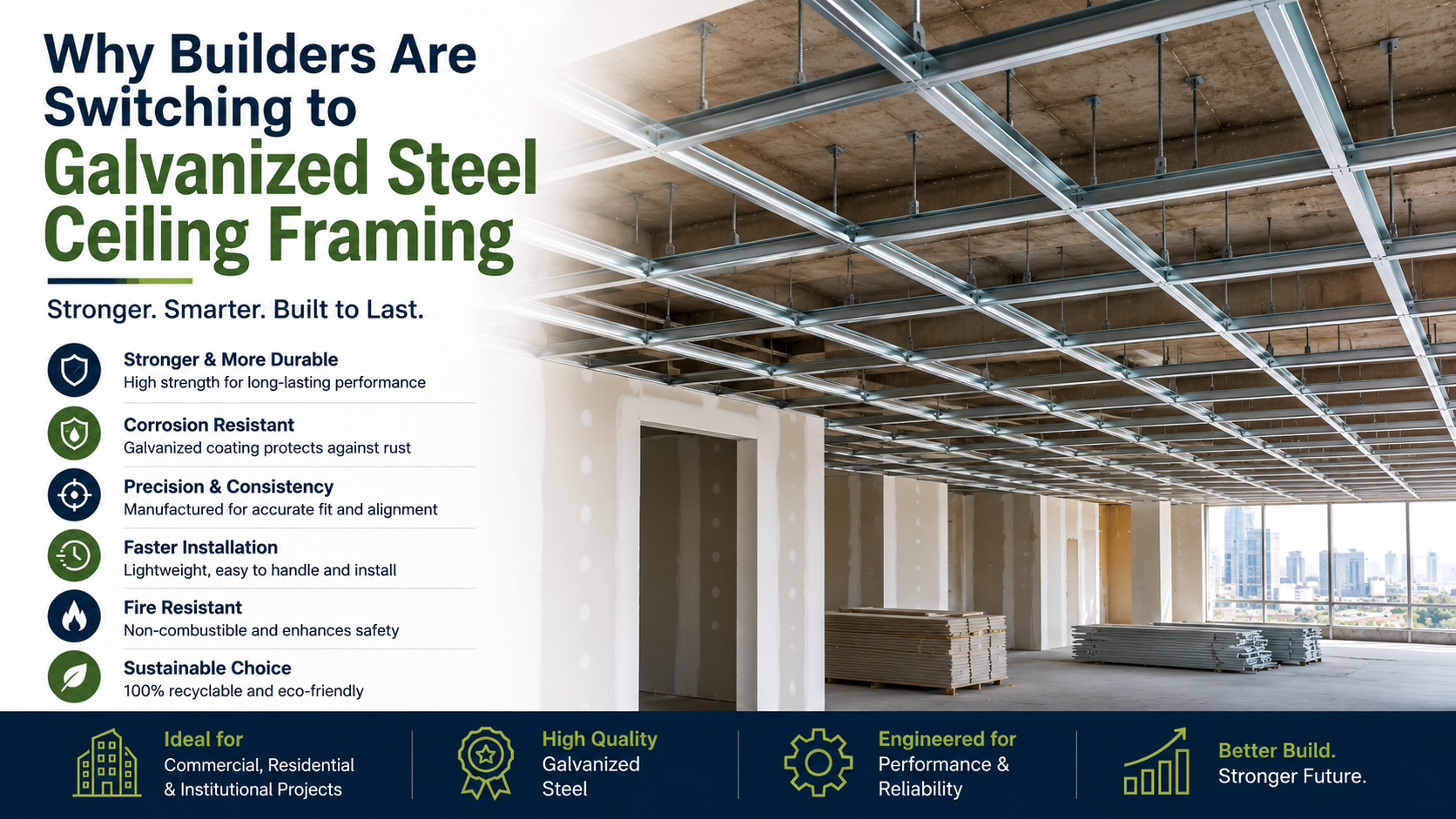
Why Builders Are Switching to Galvanized Steel Ceiling Framing
A ceiling may look simple after completion, but the framework hidden above it determines how well the system performs over time. Builders and contractors increasingly need framing materials that are dimensionally consistent, easy to handle, compatible with modern ceiling boards, and suitable for demanding project schedules.
That explains Why Builders Are Switching to Galvanized Steel Ceiling Framing for many residential, commercial, healthcare, hospitality, and institutional projects. Galvanized steel channels provide a practical combination of strength, dimensional accuracy, corrosion protection, and installation efficiency.
The decision is not based on one benefit alone. Modern construction teams are looking at the complete lifecycle of a ceiling system-from procurement and storage to installation, maintenance, and eventual replacement. This article examines the practical reasons behind the growing use of galvanized steel ceiling framing.
Why is Galvanized Steel Framing Becoming More Common in Modern Construction?
Galvanized steel ceiling framing is becoming more common because it provides predictable dimensions, corrosion protection, and a stable framework for modern ceiling systems. For contractors working on projects where consistency and installation speed matter, factory-formed GI channels can simplify site execution and reduce variations in framing quality.
1. Greater Dimensional Consistency
One important reason Why Builders Are Switching to Galvanized Steel Ceiling Framing is the consistency of roll-formed steel profiles.
In a large project, hundreds or thousands of channel lengths may be required. Variations in profile dimensions can create alignment problems, affect board fixing, and increase adjustment work at the site.
Precision roll-formed channels are manufactured to controlled dimensions. This can help contractors achieve:
- More uniform ceiling levels
- Consistent framing geometry
- Better alignment between components
- Predictable installation procedures
- Cleaner board fixing surfaces
Dimensional consistency is especially valuable in offices, hospitals, hotels, educational buildings, and other projects with large ceiling areas.
For a detailed explanation of the components used in a framing system, read our False Ceiling Channel Types Explained: Complete Guide for Builders & Contractors.
2. Protection Against Corrosion
Galvanized steel has a zinc coating that helps protect the underlying steel from corrosion. This makes it a practical material for concealed ceiling framing where future access for inspection or replacement may be difficult.
The actual service performance of a channel depends on several factors, including coating quality, storage conditions, indoor environment, water leakage, and installation practices. Galvanization should not be treated as a substitute for proper moisture management.
Builders should still pay attention to:
- Roof and plumbing leakage
- Condensation-prone areas
- Improper material storage
- Damaged channel surfaces
- Persistent high-humidity conditions
A good ceiling system combines suitable materials with sound building design and proper installation.
How Does Steel Ceiling Framing Improve Project Execution?
Steel ceiling framing can improve project execution by offering standardized profiles that are easy to measure, cut, align, and assemble according to an approved ceiling layout. This can make work more systematic, particularly on large projects where multiple installation teams must maintain consistent workmanship.
3. Faster and More Organized Installation
Construction schedules are becoming tighter. Delays in interior work can affect electrical finishing, HVAC commissioning, painting, flooring protection, and final handover.
Galvanized ceiling framing supports an organized installation sequence. Once the suspension layout and ceiling level are established, the framing components can be installed according to the system design.
Depending on the selected ceiling system, the framework may include:
- Primary supporting members
- Intermediate channels
- Ceiling sections
- Perimeter channels
- Suspension rods or hangers
- Approved connectors and fasteners
The components should be selected and installed as a complete system. Substituting profiles or changing spacing without technical review can affect performance.
4. Easier Coordination With Building Services
Modern ceilings often contain much more than lighting. Above-ceiling spaces may accommodate electrical cables, air-conditioning services, fire protection systems, communication networks, and access panels.
A properly planned GI ceiling framework helps different site teams coordinate their work more effectively.
Before closing the ceiling, contractors should confirm:
- Service routes are complete
- Access panels are correctly positioned
- Heavy fixtures have independent support where required
- Ceiling framing has not been cut without approval
- Hangers do not interfere with building services
- Final levels and alignment have been checked
Good coordination is one of the less visible reasons Why Builders Are Switching to Galvanized Steel Ceiling Framing. The benefit is not simply the channel itself; it is the predictability a properly designed framing system brings to site execution.
For practical site guidance, explore our False Ceiling Channel Installation Guide.
What Performance Advantages Matter Most to Builders?
Builders value ceiling framing that remains stable, supports the specified ceiling system, provides reliable fixing surfaces, and requires limited corrective work when correctly designed and installed. Galvanized steel channels are particularly useful where dimensional stability and repeatable installation quality are important.
5. Structural Stability and Load Distribution
A false ceiling framework must safely transfer its intended loads to the supporting building structure.
Different framing members perform different roles. Some act as main supporting members, while others provide intermediate support or a fixing surface for ceiling boards.
Performance depends on factors such as:
- Channel profile and thickness
- Steel properties
- Hanger spacing
- Channel spacing
- Ceiling board weight
- Service loads
- Connection details
- Installation workmanship
There is no single channel specification that is suitable for every ceiling. Project teams should select the framing system according to the approved design and the requirements of the ceiling application.
6. Better Dimensional Stability
A major advantage of steel framing is dimensional stability. Steel does not experience termite attack and does not behave like moisture-sensitive organic framing materials.
This helps explain Why Builders Are Switching to Galvanized Steel Ceiling Framing in projects where consistency is important.
Stable framing can help maintain:
- Ceiling alignment
- Board support
- Joint consistency
- Fixture positioning
- Perimeter detailing
However, ceiling cracking can have many causes, including structural movement, incorrect joint treatment, moisture, poor installation, or unsuitable spacing. Quality framing is one part of a complete ceiling system-not a guarantee against every defect.
7. Suitability for Different Building Types
Galvanized steel ceiling framing can be used in a wide range of buildings when the system is properly designed for the application.
Typical applications include:
- Corporate offices
- Hospitals and clinics
- Educational institutions
- Hotels
- Retail spaces
- Airports and transport facilities
- Residential developments
- Institutional buildings
- Selected industrial interiors
Each application may have different requirements for acoustics, fire performance, moisture exposure, access, and service integration. The framing should therefore be selected as part of the complete tested or specified ceiling assembly.
Why Do Quality and Manufacturing Accuracy Matter?
Quality manufacturing and precise profile dimensions play a crucial role in the overall performance of a false ceiling system. Even a carefully planned ceiling design can become difficult to install if the channels vary in size, shape, or alignment. Builders should evaluate profile dimensions, steel thickness, coating condition, straightness, edge quality, and compatibility with the intended ceiling system before accepting material.
8. Precision Roll Forming and Profile Accuracy
Cold roll forming allows steel coils to pass through a controlled sequence of forming rolls until the required profile geometry is achieved.
For ceiling channels, consistent forming is important because irregular profiles can create practical problems during installation.
Buyers should inspect for:
- Consistent profile dimensions
- Straight channel lengths
- Uniform bends
- Clean edges
- Surface condition
- Material traceability where specified
- Compliance with purchase specifications
For more information about manufacturing methods, see our Custom Roll Formed Steel Profiles Guide.
9. Quality Checks Before Installation
Procurement teams should not select ceiling channels on price alone. A lower purchase rate may not represent better project value if inconsistent material leads to rejection, installation delays, or rework.
Before approving a batch, check:
- Whether the dimensions match the purchase specification
- Whether the thickness meets the approved requirement
- Whether profiles are straight and free from excessive distortion
- Whether the galvanized surface is in acceptable condition
- Whether channels have been properly packed and stored
- Whether supporting documentation is available where required
- Whether the supplied profile matches the approved ceiling system
A simple receiving inspection can prevent unsuitable material from reaching the installation area.
How Should Builders Choose a Reliable Ceiling Channel Supplier?
Builders should choose a supplier based on product consistency, manufacturing capability, specification clarity, quality control, delivery reliability, and technical communication. The right supplier should understand that commercial construction requires repeatable quality across the entire order, not just an acceptable sample.
10. Evaluating the Supplier Beyond Price
One of the clearest reasons Why Builders Are Switching to Galvanized Steel Ceiling Framing is the industry’s broader move toward standardized construction systems and measurable quality.
When comparing suppliers, contractors and procurement teams, they should ask:
- Can the supplier maintain dimensional consistency across large quantities?
- Are material specifications clearly documented?
- What quality checks are performed during production?
- Can the supplier support scheduled project deliveries?
- Is the packaging suitable for transport and site storage?
- Can technical requirements be discussed before production?
- Is the supplier experienced in roll-formed steel profiles?
The objective is to choose materials that meet the project’s technical requirements while delivering consistent quality and long-term value. It is to select a product that meets the project specification consistently and arrives according to the construction schedule.
Rudran Infra Metals focuses on precision roll-formed steel profiles for construction and industrial applications. Product selection should always be based on approved project specifications, intended application, and relevant engineering requirements.
To understand what to inspect before procurement, read our GI False Ceiling Channel Quality Guide.
Conclusion
The shift toward galvanized steel ceiling framing reflects a wider change in construction: builders want predictable materials, controlled dimensions, organized installation, and reliable long-term performance.
That is the practical answer to Why Builders Are Switching to Galvanized Steel Ceiling Framing. The value lies in the complete system-from precision manufacturing and corrosion protection to correct specification, installation, and quality inspection.
For builders and contractors, choosing the right ceiling channel is not simply a material purchase. It is a decision that can influence installation efficiency, finishing quality, maintenance planning, and overall project execution.
Contact us today, Planning a commercial, residential, or institutional project that requires precision roll-formed GI ceiling channels? Contact Rudran Infra Metals to discuss your specifications, quantities, profile requirements, and project delivery schedule.
Frequently Asked Questions
1. Why Are Builders Choosing Galvanized Steel for Ceiling Framing?
Builders choose galvanized steel framing for its strength, dimensional accuracy, corrosion resistance, and ease of installation.
2. Is Galvanized Steel Framing Suitable for Commercial Buildings?
Yes. It is suitable for offices, hospitals, schools, hotels, shopping centres, and other commercial projects when properly specified and installed.
3. Does Galvanized Steel Framing Prevent Ceiling Cracks?
It provides a stable framework, but cracks can still occur due to moisture, building movement, poor joint treatment, or incorrect installation.
4. Can GI Ceiling Channels Be Used in Hospitals and Schools?
Yes. GI ceiling channels can be used in institutional buildings as part of a properly designed ceiling system.
5. Does Galvanized Steel Ceiling Framing Resist Corrosion?
Yes. Its zinc coating helps protect the steel from corrosion, although proper storage, installation, and moisture control remain important.