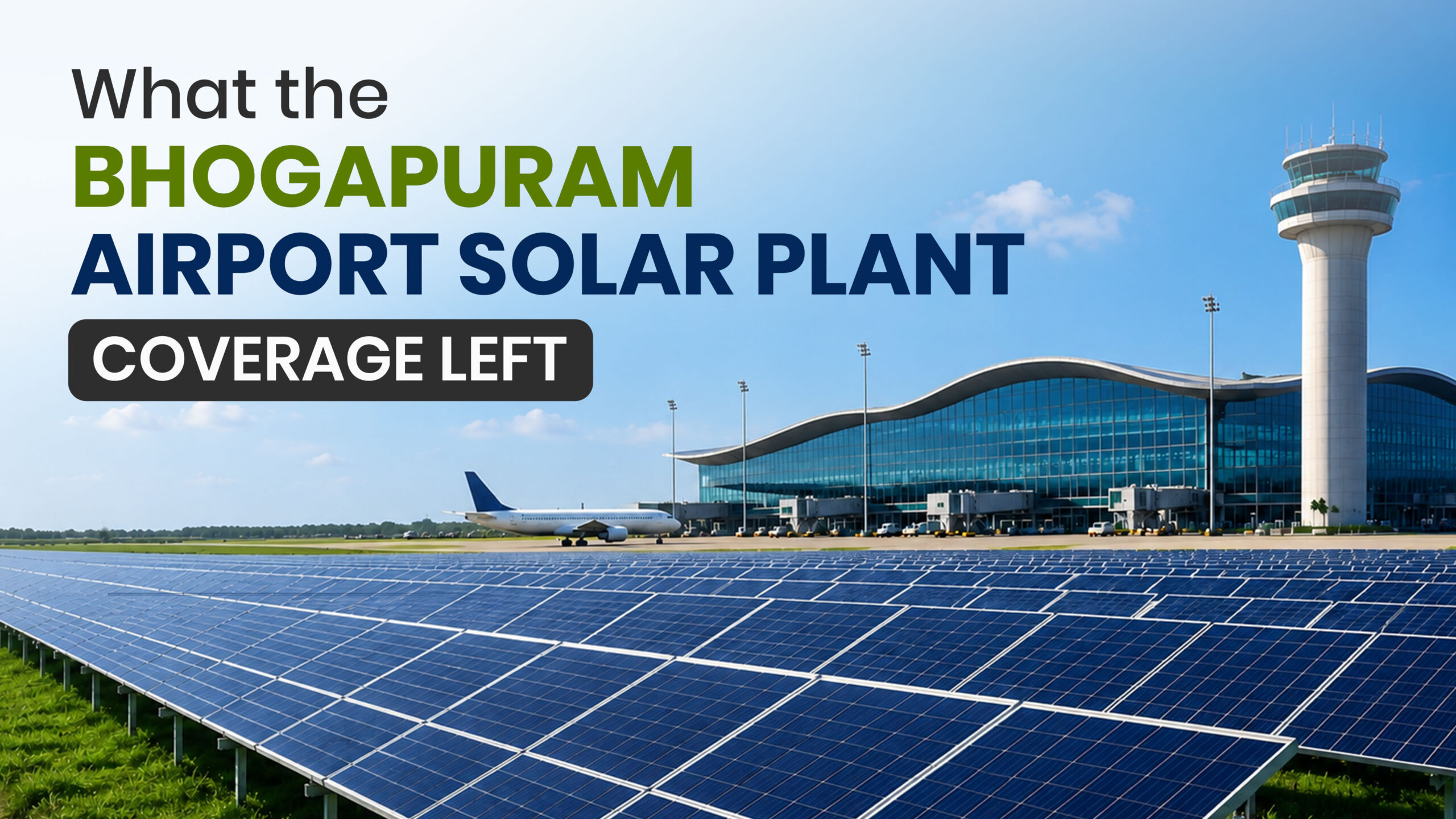
What the Bhogapuram Airport Solar Plant Coverage Left Out
On August 1, Prime Minister Narendra Modi opened the Alluri Sitarama Raju International Airport in Bhogapuram. After years of land clearances and changing approvals, the airport is ready to serve six million travellers each year. As Andhra Pradesh’s newest international hub, it has drawn a lot of attention as a major project worth over ₹5,640 crore and backed by the Prime Minister.
Most news stories highlighted the airport’s AI-powered operations center, biometric check-ins, and a terminal roof inspired by Araku Valley. Green features like energy-efficient lighting, rainwater harvesting, and a 5 MW solar power plant were only mentioned in passing.
The solar plant was barely discussed, usually mentioned only briefly before the focus shifted back to how many passengers the airport can handle.
Yet, this short mention might actually point to the project’s most important long-term effect.
While headlines talked about solar panels, the real challenge is making sure the structure underneath stays reliable for years.
Examining this often-overLooking closely at this often-missed detail matters because it’s more important than most people realise
A 5 MW solar installation is a major infrastructure investment, not just a small rooftop setup.
Projects like this need steel foundations, careful load calculations, and a design meant to last for decades.
This kind of project should last long after the media coverage fades.
The airport’s proximity to the Bay of Bengal introduces ongoing engineering challenges throughout its lifespan.
Bhogapuram sits just a few kilometres from the Bay of Bengal. While this is great for travelers, engineers have to deal with salty air, seasonal humidity, and long-term exposure to the elements that affect all Salt in the air slowly wears down window frames, gate hinges, exposed steel, and other outdoor parts. Solar installations near the coast face these problems even more.ts on a larger scale.
Solar panels are the simpler part, since manufacturers usually offer 25-year performance warranties and clear industry standards. The supporting structure, though, is less standardized and not talked about as much.
The Blind Spot Nobody Budgets For
When buying solar systems in India, people look at panel efficiency and how quickly they degrade, and at inverters for conversion losses. The mounting structure, which holds everything together, is seen as necessary but rarely gets much attention.
This way of thinking might work in dry inland areas. But along the Andhra coast, the environment calls for different engineering standards. Structures that look the same on paper can behave very differently over time depending on where they are.
Structural engineers say that coastal areas in Gujarat, Tamil Nadu, Kerala, and Andhra Pradesh have high corrosion risks. Salt in the air speeds up the breakdown of steel that isn’t well protected. Over time, corrosion eats away at the safety margin, so structures that seem the same as inland ones may not hold up as well after a few years.
It’s hard to spot this kind of problem from far away.
For example, you can’t see a rusting bolt in aerial photos of a new terminal roof.
These problems usually show up in maintenance reports years later, often after the media has moved on.
Why This Matters Beyond One Airport
Bhogapuram probably won’t be the last coastal project in Andhra Pradesh to use solar power. The state is pushing for more renewable energy as part of India’s clean energy goals. The industrial corridor from Vizianagaram to Visakhapatnam is likely to see more projects like airports, ports, and logistics parks, all facing coastal conditions.
This brings up a question that’s often missed when buying equipment: how much do evaluation criteria really consider a solar project’s coastal location?
In reality, mounting structures are usually judged by how much the steel costs per kilogram. While that might seem fair, it ignores the special durability needs of different places. Designs for dry inland areas and coastal sites might look alike and cost about the same, but they can perform very differently over time.
This choice is crucial because it affects maintenance costs, reliability, and long-term performance. It can decide if a project runs smoothly for its full 25-year warranty or needs expensive repairs much sooner, wiping out any early savings.
What EPCs and Developers Are Starting to Learn
Contractors working on coastal projects are now putting more focus on corrosion resistance in their designs. They often ask about coating or galvanizing, whether wind load calculations consider local cyclone risks, and if manufacturers can deliver materials on time for big projects.
Getting mounting structures delivered on time is crucial, since delays can hold up not just the solar installation but the whole project and the opening of the facility.
Specialist manufacturers are important for solving these problems. Rudran Infra Metals, a manufacturer of cold roll formed solar mounting structures in Hyderabad, designs steel support systems for different environmental conditions, recognizing that solutions suitable for inland installations may require different specifications for coastal projects. Although these structures receive far less attention than solar panels or inverters, they play a significant role in long-term system reliability.
These technical details rarely get mentioned at inaugurations and usually only show up years later in maintenance records checked by facility teams.
This is typical of good infrastructure: the most important parts often go unnoticed. Airports get attention when they open, but the support structures are rarely mentioned. Their real success shows in years of steady, reliable performance.
Key Takeaways
- Bhogapuram’s new international airport includes a 5 MW solar power plant for its green building certification, along with energy-efficient HVAC, lighting, and rainwater harvesting systems.
- Because the airport is close to the Bay of Bengal, its solar infrastructure faces a high-corrosion coastal environment, just like in Gujarat, Tamil Nadu, and Kerala.
- Solar mounting structures, not just the panels, are key to reaching the full 25-year design life, especially in salty air environments.
- Corrosion in structures that aren’t properly protected or specified builds up slowly and often goes unnoticed for years after installation.
- If procurement decisions focus only on the cost per kilogram of steel, they might miss how the structure will perform in the long run, especially in coastal areas.
- As Andhra Pradesh builds more coastal solar and infrastructure projects, structural specifications are becoming more important in how EPCs are evaluated.
The Part That Outlasts the Headlines
In a few years, people probably won’t remember the exact date Bhogapuram’s solar plant started running. What will matter is whether it keeps generating power reliably and efficiently. Good infrastructure usually works in the background. Opening day is just the beginning, not the end. Over the next twenty-five years, Bhogapuram Airport’s solar plant will face salty winds, monsoons, and all the challenges of a coastal environment. If it keeps providing clean energy year after year, most passengers won’t even think about the structures holding it up-and that’s the point. The best infrastructure isn’t remembered just for lasting, but for quietly doing its job.
Maybe the best praise an engineer can get is for building something. The highest compliment might be creating infrastructure that users never have to worry about.