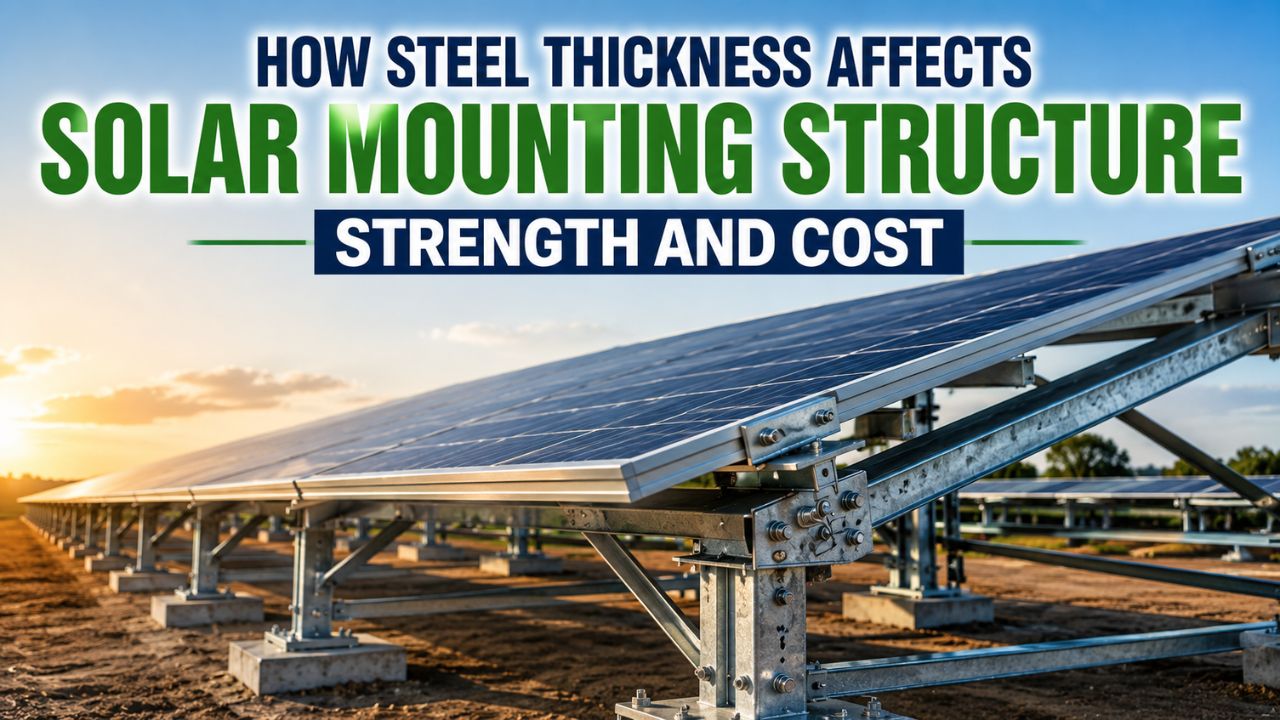
How Does Steel Thickness Affect Solar Mounting Structure Strength?
Steel thickness directly influences the strength, stiffness, weight, and material consumption of a solar mounting structure. However, using thicker steel does not automatically create a better structure. The right thickness depends on span, loads, profile geometry, steel grade, connections, corrosion protection, and project-specific engineering requirements.
For solar EPCs and project developers, thickness should therefore be treated as an engineering parameter, not simply a purchasing specification.
Several factors influence the required thickness:
- Wind loads
- Solar panel weight
- Structural span
- Support spacing
- Profile geometry
- Steel grade
- Connection design
- Foundation arrangement
- Environmental conditions
A correctly engineered thinner section can sometimes perform better than an unnecessarily thick section with an inefficient profile.
Why Is Steel Thickness Important in Solar Structures?
Steel thickness affects how a structural member behaves when exposed to bending, compression, tension, and local stresses. It also influences the weight of each component and the amount of steel required for a complete project.
Thickness and Structural Stiffness
Increasing thickness generally increases the cross-sectional area and can improve resistance to certain forms of deformation. However, structural stiffness also depends heavily on the shape and depth of the profile.
For example, a properly designed C-section, Z-section, hat section, or other roll-formed profile can achieve useful structural performance without simply increasing material thickness.
This is why solar structure design should consider the complete profile rather than thickness alone.
Thickness and Deflection
Strength is not the only consideration. Engineers also need to control deflection.
Excessive movement can affect:
- Panel alignment
- Module connections
- Structural appearance
- Cable routing
- Long-term system performance
The acceptable deflection depends on the project design and applicable engineering requirements.
Does Thicker Steel Always Mean a Stronger Solar Mounting Structure?
Not necessarily. A thicker section may increase material strength in certain loading conditions, but overall structural performance depends on the complete section design and how the component is supported.
A solar mounting structure is a system made up of several interconnected components, including:
- Columns or posts
- Rafters
- Purlins
- Bracing members
- Rails
- Fasteners
- Foundations
If one component is made thicker without reviewing the rest of the system, the additional material may not provide a meaningful improvement in overall performance.
Profile Geometry Matters
Roll forming allows manufacturers to create profiles with bends, lips, ribs, and other geometric features.
These features can improve the efficiency of a steel section by placing material where it contributes effectively to structural performance.
This is one reason precision roll-formed steel profiles are widely used in solar mounting applications.
How Does Steel Thickness Affect Solar Structure Cost?
Steel thickness has a direct effect on material consumption and therefore can influence the cost of a solar mounting structure. A thicker profile generally contains more steel per metre, increasing its weight and potentially increasing the total material cost.
However, the relationship between thickness and total project cost is not always straightforward.
A cost comparison should consider:
- Steel weight per metre
- Total structural weight
- Material grade
- Coating requirements
- Manufacturing cost
- Transportation
- Installation
- Foundation requirements
Using a heavier section may increase material and transportation costs, while an efficiently designed section may achieve the required performance with less steel.
Why Lowest Steel Weight Is Not Always the Best Option
Reducing steel consumption can lower initial costs, but excessive optimization may create other problems if the structure does not meet the required design criteria.
An economical structure should provide the required:
- Strength
- Stiffness
- Stability
- Connection performance
- Durability
The objective should be optimized steel usage, not simply minimum steel usage.
What Role Does Wind Load Play in Selecting Steel Thickness?
Wind is one of the most important environmental loads considered when designing solar mounting structures, particularly for open ground-mounted systems and exposed rooftops.
Wind can create:
- Downward pressure
- Uplift forces
- Lateral forces
- Torsional effects
- Vibrations
The required structural sections depend on the site’s design wind conditions and the geometry of the solar array.
For Indian projects, engineers commonly refer to applicable provisions of IS 875 for wind loading, together with other relevant structural design requirements.
A project located in a high-wind or cyclone-prone region may require different structural specifications from a project in a less exposed location.
This means copying a thickness specification from another solar project is not necessarily appropriate.
How Does Steel Grade Work With Thickness?
Steel thickness and steel grade are related but different design parameters.
Thickness determines the physical amount of material in the section, while steel grade defines important mechanical properties such as yield strength.
For example, two sections with the same thickness but different steel grades may have different design capacities.
Engineers therefore need to evaluate:
- Steel grade
- Yield strength
- Tensile strength
- Section geometry
- Thickness
- Effective section properties
The final specification should be selected through engineering calculations rather than by thickness alone.
How Does Galvanizing Affect the Thickness Decision?
Corrosion protection is particularly important for solar structures because they remain exposed to outdoor conditions for many years.
Galvanization provides a protective zinc coating over steel. However, the coating should not be treated as a replacement for appropriate structural thickness.
When selecting a galvanized solar structure, project teams should consider:
- Base steel thickness
- Coating specification
- Environmental exposure
- Coastal or industrial conditions
- Expected service life
- Handling and installation practices
For coastal projects, corrosion protection deserves particular attention because salt-laden air can accelerate deterioration.
Our Solar Structure Corrosion Prevention Guide provides more information about protecting solar structures in coastal and high-salinity environments.
What Happens If Steel Thickness Is Too Low?
Using an unsuitable thickness can create structural and operational concerns if the section does not meet the project’s required design capacity.
Potential problems may include:
- Excessive deflection
- Local buckling
- Reduced connection capacity
- Increased vibration
- Deformation during handling
- Reduced structural reliability
These issues cannot be judged simply by looking at the steel section.
Engineering calculations and appropriate testing or verification are required to determine whether a particular profile is suitable for the intended application.
Can Using Excessive Steel Thickness Increase Project Costs?
Using excessive thickness can also be inefficient.
An unnecessarily heavy section may result in:
- Higher material costs
- Increased transportation weight
- More difficult handling
- Higher foundation loads
- Additional fabrication requirements
For large solar projects, even a small increase in steel weight per metre can become significant when multiplied across thousands of structural members.
This is why steel optimization is an important part of solar structure engineering.
How Can EPCs Optimize Steel Thickness and Cost?
EPC contractors can optimize structural costs by considering the complete design rather than selecting components based only on thickness.
1. Start With Site-Specific Loads
Determine the project’s wind, seismic, snow, and other applicable design loads.
2. Optimize the Profile
Consider profile geometry alongside thickness. Roll-formed sections can be engineered for specific applications.
3. Check Connection Design
A strong steel section is not useful if the connection cannot safely transfer the required loads.
4. Consider Foundation Loads
Changes in structural weight and geometry can affect foundation requirements.
5. Evaluate Corrosion Protection
Select the appropriate coating and material specification for the project’s environmental conditions.
6. Compare Total Project Cost
When estimating the overall project budget, account for the complete cost of steel, manufacturing, logistics, installation, and foundation work rather than focusing solely on the steel’s per-kilogram rate.
Why Is Precision Manufacturing Important?
Once the engineering specification is finalized, manufacturing consistency becomes critical.
Small variations in profile dimensions or thickness can affect how components fit together during installation. Precision roll forming helps maintain consistent geometry across production batches.
Quality checks may include:
- Material thickness verification
- Profile dimension checks
- Straightness inspection
- Hole position verification
- Surface and coating inspection
- Batch quality documentation
For customized solar projects, manufacturing should follow approved drawings and technical specifications.
Rudran Infra Metals manufactures solar mounting structures and precision roll-formed steel profiles for project-specific applications, with a focus on dimensional consistency and controlled manufacturing.
What Should Buyers Ask Before Ordering Solar Mounting Structures?
Before finalizing a supplier, EPCs and procurement teams should ask:
- What steel grade is being supplied?
- What is the specified base metal thickness?
- What profile geometry is being used?
- Has the structure been designed for the project’s site loads?
- What corrosion protection is specified?
- How are dimensions and thickness verified?
- Are fabrication drawings available for approval?
- What quality inspections are performed?
- Can the manufacturer maintain consistency for bulk quantities?
- Can the supplier manufacture custom profiles if required?
These questions help buyers evaluate the complete structural solution rather than focusing only on price per kilogram.
Conclusion
Steel thickness is an important part of solar mounting structure design, but it should never be considered in isolation. Structural strength depends on a combination of thickness, steel grade, profile geometry, loading conditions, connections, support spacing, and foundation design.
For EPC contractors and developers, the goal should be to find the right balance between structural performance and material efficiency. An unnecessarily thick structure can increase project costs, while an underspecified section can create serious performance concerns.
Site-specific engineering, precision manufacturing, appropriate corrosion protection, and reliable quality control are the foundations of a well-designed solar mounting structure.
Planning a solar project and need precision-engineered mounting structures or custom roll-formed steel profiles?
Contact Rudran Infra Metals to discuss your project specifications, structural requirements, quantities, and manufacturing needs.
Frequently Asked Questions
1. Does thicker steel always make a solar structure stronger?
No. Structural performance depends on thickness, profile geometry, steel grade, loading, connections, and support conditions.
2. How does steel thickness affect solar structure cost?
Greater thickness generally increases steel weight and material consumption, which can increase manufacturing, transportation, and overall project costs.
3. What thickness is suitable for a solar mounting structure?
There is no universal thickness. The appropriate specification should be determined through project-specific structural calculations.
4. Is steel grade more important than thickness?
Neither should be considered independently. Engineers evaluate steel grade, thickness, section properties, and loading together.
5. Why is galvanized steel used for solar structures?
Galvanization provides zinc-based corrosion protection, helping steel structures withstand outdoor environmental exposure.