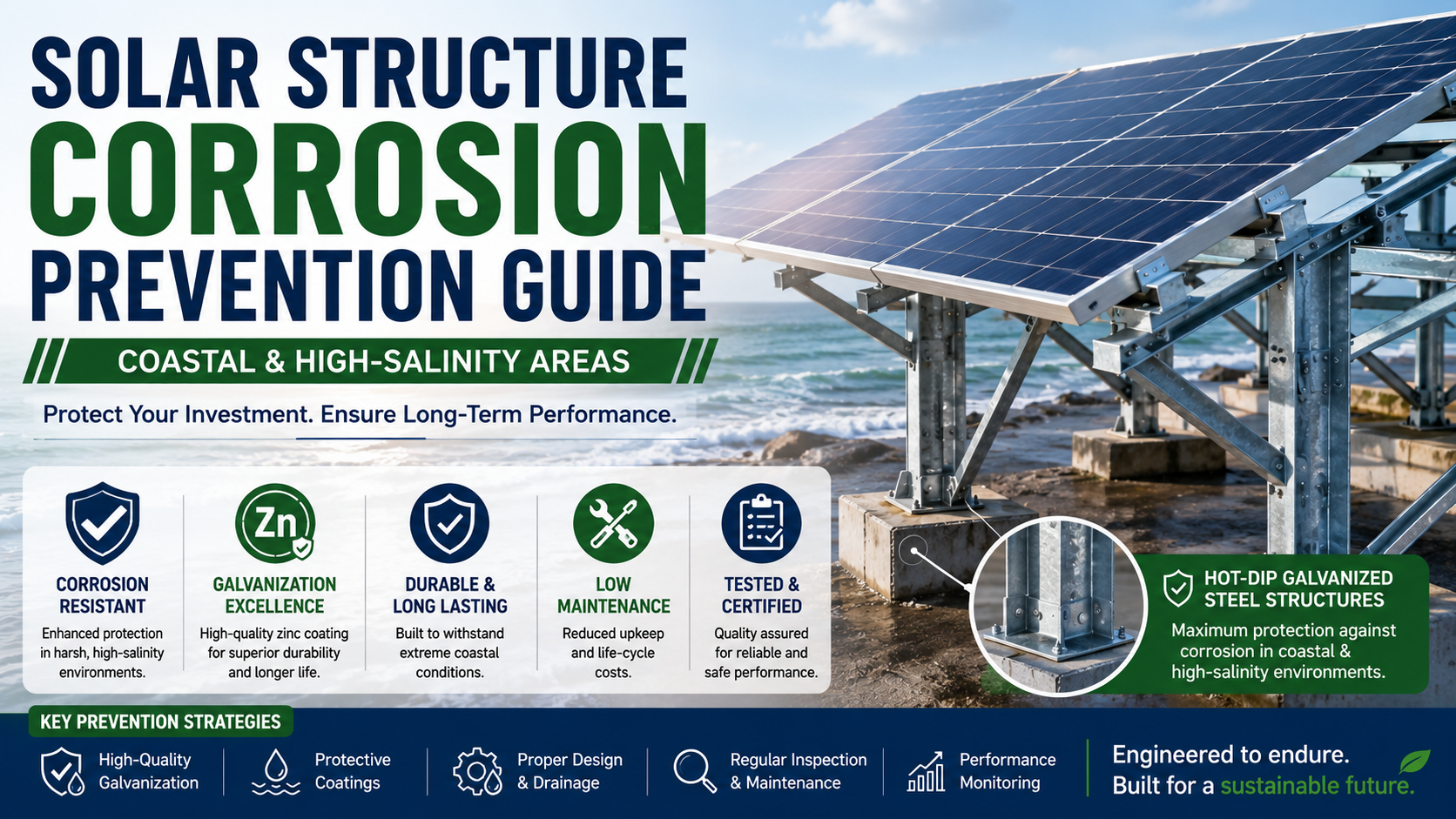
Solar projects built near coastlines or in high-salinity environments face a persistent engineering challenge: corrosion. The risk may begin gradually, but over time, inadequate protection can affect mounting structure components, connections, fasteners, and the overall reliability of the support system.
A solar mounting structure can appear perfectly sound at the time of delivery. Its long-term performance, however, depends on several connected factors. Steel selection, corrosion protection, fabrication quality, connection detailing, drainage, transport, installation practices, and maintenance all influence how the structure performs in an aggressive environment.
For EPC contractors and solar project developers, corrosion control should be considered during design and procurement. Waiting until visible rust appears often turns a manageable issue into a more complex maintenance problem.
This guide explains why corrosion develops, where it commonly appears, and how project teams can reduce the risk through better specifications, quality control, installation practices, and ongoing inspection.
Why Do Solar Mounting Structures Face Higher Corrosion Risk in Coastal Areas?
Solar mounting structures in coastal locations face greater corrosion exposure because airborne salts, moisture, and prolonged humidity create conditions that can accelerate the deterioration of inadequately protected steel surfaces.
The actual corrosion risk of a site cannot be judged only by its distance from the sea. Local wind direction, salt deposition, industrial emissions, condensation cycles, drainage conditions, and the amount of time a surface remains wet can all influence exposure severity.
Important risk factors include:
- Salt carried through the air
- High relative humidity
- Regular condensation
- Poor drainage around the structure
- Water-retaining structural details
- Industrial contaminants
- Damage to protective surfaces
- Untreated field modifications
- Contact between incompatible metals
- Inadequate inspection and maintenance
Corrosion should not be viewed as a cosmetic concern alone. Progressive material deterioration may eventually affect structural sections, fasteners, joints, and connection performance.
What Warning Signs Can Indicate Early Corrosion?
The first signs of corrosion may appear long before significant structural deterioration occurs. Routine inspections give O&M teams the opportunity to identify vulnerable areas and address the underlying cause while corrective work is still manageable.
Inspection teams should watch for:
- White deposits or corrosion products on zinc-coated surfaces
- Small patches of red rust
- Rust staining around bolts, nuts, and washers
- Changes in appearance near edges and corners
- Corrosion around drilled or altered areas
- Scratches, abrasion, or coating damage
- Water or debris collecting inside profiles
- Rust marks running below connection points
Finding these indicators early helps maintenance teams trace the source of the problem and apply suitable corrective measures before localized deterioration develops into wider damage.
How Does Galvanization Help Protect Solar Mounting Structures?
Galvanization protects steel by applying a zinc-based coating to its surface. This protective layer separates the underlying steel from environmental exposure while also offering sacrificial protection in certain small, locally exposed areas.
This makes galvanized steel suitable for many outdoor structural applications. However, corrosion protection should be specified according to the project’s environmental conditions and design requirements.
A single coating specification should not automatically be assumed suitable for every solar project. A dry inland installation and a high-humidity coastal project can experience significantly different exposure conditions.
Why Should Corrosion Protection Be Selected for Each Site?
The appropriate protection strategy depends on the actual operating environment.
Project teams should consider:
- Site corrosivity
- Coastal influence
- Salt deposition levels
- Relative humidity
- Duration of surface wetness
- Industrial pollution
- Required project service life
- Future inspection accessibility
- Maintenance strategy
For more aggressive environments, the engineering team may specify additional or enhanced protection measures based on the site assessment, project requirements, and relevant standards.
Why Is Consistent Coating Quality Important?
A corrosion protection system can be weakened by small areas of poor coverage or physical damage.
Bare spots, uneven protection, handling damage, and inadequately repaired field modifications can become starting points for localized corrosion. Quality control should therefore assess both the specified protection requirement and the physical condition of the finished component.
Inspection activities may include:
- Checking coating thickness
- Performing visual surface inspections
- Looking for exposed or damaged areas
- Inspecting corners and edges
- Reviewing repaired locations
- Verifying quality records
Final acceptance criteria should follow the approved project specification and applicable standards.
Which Areas of a Solar Mounting Structure Need Extra Attention?
Certain parts of a solar mounting structure are more likely to experience moisture retention, mechanical damage, or concentrated contamination. Connections, field-modified sections, low points, cut edges, drilled holes, and drainage-restricted areas require careful attention.
Corrosion prevention is therefore a combination of material selection, intelligent structural detailing, controlled manufacturing, and careful site execution.
Cut Edges and Field Modifications
Site cutting, drilling, grinding, or welding may affect the original protective system.
Where field modification is unavoidable, the affected location should be treated according to the approved repair procedure. Applying an unsuitable coating without checking compatibility or project requirements may not provide the required protection.
The need for field modifications can be reduced through:
- Accurate engineering drawings
- Precision punching
- Correct hole positioning
- Clear component identification
- Dimensional checks before dispatch
Better manufacturing accuracy reduces unnecessary site work and helps preserve the intended corrosion protection system.
Bolts, Nuts, Washers, and Connections
Fasteners may be small compared with the main structural members, but their role is critical.
Connection areas can become vulnerable when moisture remains trapped, surfaces are damaged, components are incorrectly substituted, or material compatibility has not been considered.
Inspection teams should review:
- General fastener condition
- Proper washer seating
- Visible staining around connections
- Signs of retained moisture
- Surface damage around joints
- Unapproved component replacements
Fastener selection should form part of the overall corrosion management strategy rather than being treated as a separate purchasing decision.
Water-Retention Areas
Structural details that allow water, mud, debris, or salt deposits to remain in place can increase the duration of surface wetness.
Drainage should be considered during the design process. The orientation of profiles, connection geometry, openings, overlaps, and low points can determine whether water drains away or remains trapped.
Effective detailing can help minimize:
- Standing water
- Long periods of surface wetness
- Concentrated salt deposits
- Mud and debris buildup
- Difficult inspection areas
Good structural detailing and appropriate material protection should support each other.
How Can Corrosion Risk Be Reduced Throughout the Project Lifecycle?
Effective corrosion prevention requires coordinated action from the earliest planning stage through operation and maintenance. Focusing only on the coating while overlooking design, handling, installation, or inspection can leave avoidable weak points.
Assess Environmental Exposure Before Finalizing Specifications
Site conditions should be evaluated before the corrosion protection requirements are finalized.
The assessment should consider:
- Coastal exposure
- Local humidity
- Salt contamination
- Nearby industrial activity
- Drainage conditions
- Flooding potential
- Ease of future inspection and maintenance
The resulting information should be reflected in engineering, procurement, manufacturing, and quality requirements.
Match the Protection System to the Environment
The selected protection system should reflect both site exposure and the expected service conditions of the project.
Depending on the environment and engineering requirements, hot-dip galvanizing or another specified protection system may be considered. Aggressive locations may require additional measures determined by qualified engineering professionals.
The lowest initial purchase price does not necessarily provide the lowest lifecycle cost. Poor protection decisions can lead to:
- Additional inspections
- Corrective repairs
- Premature component replacement
- Increased O&M effort
- Operational disruption
- Structural remediation work
Lifecycle performance should therefore be considered alongside initial procurement cost.
Maintain Manufacturing Quality
Corrosion performance is influenced by what happens inside the factory as well as at the project site.
Manufacturing controls should address:
- Correct raw material specifications
- Dimensional consistency
- Controlled fabrication
- Appropriate surface preparation
- Coating quality checks
- Careful material handling
- Protective packaging
Even a well-designed structure can face premature problems when production and quality control are inconsistent.
Protect Components During Transport and Installation
Damage can occur after manufacturing and before the solar plant becomes operational.
Common causes include:
- Dragging sections across the ground
- Rough unloading
- Incorrect stacking
- Abrasion between steel components
- Unnecessary grinding
- Unauthorized welding
- Careless field drilling
Installation teams should understand that the protective surface is an important part of the component’s long-term performance.
Create an Environment-Based Inspection Plan
Corrosion management continues after commissioning.
Inspection frequency should reflect environmental exposure, project requirements, and observed field performance. A high-salinity coastal location may need a different inspection approach from a dry inland site.
Key inspection areas include:
- Structural connections
- Fasteners
- Field-modified locations
- Low points
- Drainage paths
- Damaged protective surfaces
- Rust staining
- Water-retention areas
- Zones with persistent contamination
A structured inspection record enables O&M teams to track recurring issues, monitor changes over time, and address the most critical maintenance needs first.
What Should EPCs Review When Procuring Structures for Coastal Solar Projects?
EPC contractors should assess the entire corrosion protection strategy rather than looking only at the base material specification.
Procurement documents should clearly define environmental exposure, corrosion protection requirements, inspection procedures, acceptance criteria, handling expectations, and approved repair methods.
Useful questions for suppliers include:
- What steel specification is proposed?
- What corrosion protection system will be applied?
- How is protection quality verified?
- Are inspection and quality records maintained?
- How are field-modified areas treated?
- What fastener specification is recommended?
- How are finished profiles protected during transportation?
- What repair procedure is recommended for damaged areas?
- Does the structural design reduce water retention?
- What post-commissioning inspection approach is recommended?
These questions allow procurement teams to evaluate suppliers on technical capability, quality systems, and project suitability rather than comparing price alone.
Why Does Corrosion Prevention Matter for Long-Term Solar Performance?
Solar power plants are built for decades of operation, making the durability and reliability of every structural component essential to long-term project performance. The mounting system must continue supporting modules while maintaining alignment, stability, and connection integrity through years of environmental exposure.
A well-planned corrosion management strategy can support:
- More consistent structural performance
- Better maintenance planning
- Reduced need for corrective work
- Lower risk of early component replacement
- Improved connection reliability
- More efficient asset management
Corrosion is generally easier to manage when potential risks are addressed during design and procurement. Once deterioration becomes widespread across a large solar site, inspection, repair, and component replacement become more complex.
Conclusion
Protecting solar mounting structures in coastal and high-salinity environments requires more than selecting a particular steel product or coating system. Long-term performance depends on a coordinated approach involving environmental assessment, engineering design, structural detailing, manufacturing control, transportation, installation, and maintenance.
EPC contractors and project developers should define corrosion protection according to real site conditions and verify quality throughout the supply chain. Particular attention should be given to connections, cut edges, field modifications, drainage points, fasteners, and damaged protective surfaces.
Rudran Infra Metals provides precision-engineered steel solutions for solar mounting applications, with a focus on dimensional consistency, controlled manufacturing, and project-specific requirements.
Contact us today Planning a solar project in a coastal, humid, or high-salinity environment? Contact Rudran Infra Metals to discuss project specifications, quantities, technical requirements, and delivery needs. Our team supports EPC contractors and solar developers with project-focused steel solutions for solar mounting applications.
FAQs
1. Why are solar mounting structures more vulnerable to corrosion in coastal areas?
Salt-laden air, high humidity, and frequent moisture exposure can accelerate corrosion, especially where protective coatings are damaged.
2. What are the first signs of corrosion on a solar mounting structure?
Common signs include white deposits, red rust spots, rust stains near fasteners, damaged coatings, and corrosion around cut edges.
3. Is galvanization alone enough for every coastal solar project?
Not always. The required corrosion protection depends on site conditions, salt exposure, humidity, project specifications, and expected service life.
4. Which parts of a solar mounting structure should be inspected most carefully?
Check fasteners, connections, cut edges, drilled areas, field modifications, drainage points, and locations where water or debris collects.
5. How can EPC contractors reduce corrosion-related maintenance costs?
Use site-specific protection, maintain manufacturing quality, prevent installation damage, reduce unnecessary field modifications, and conduct regular inspections.