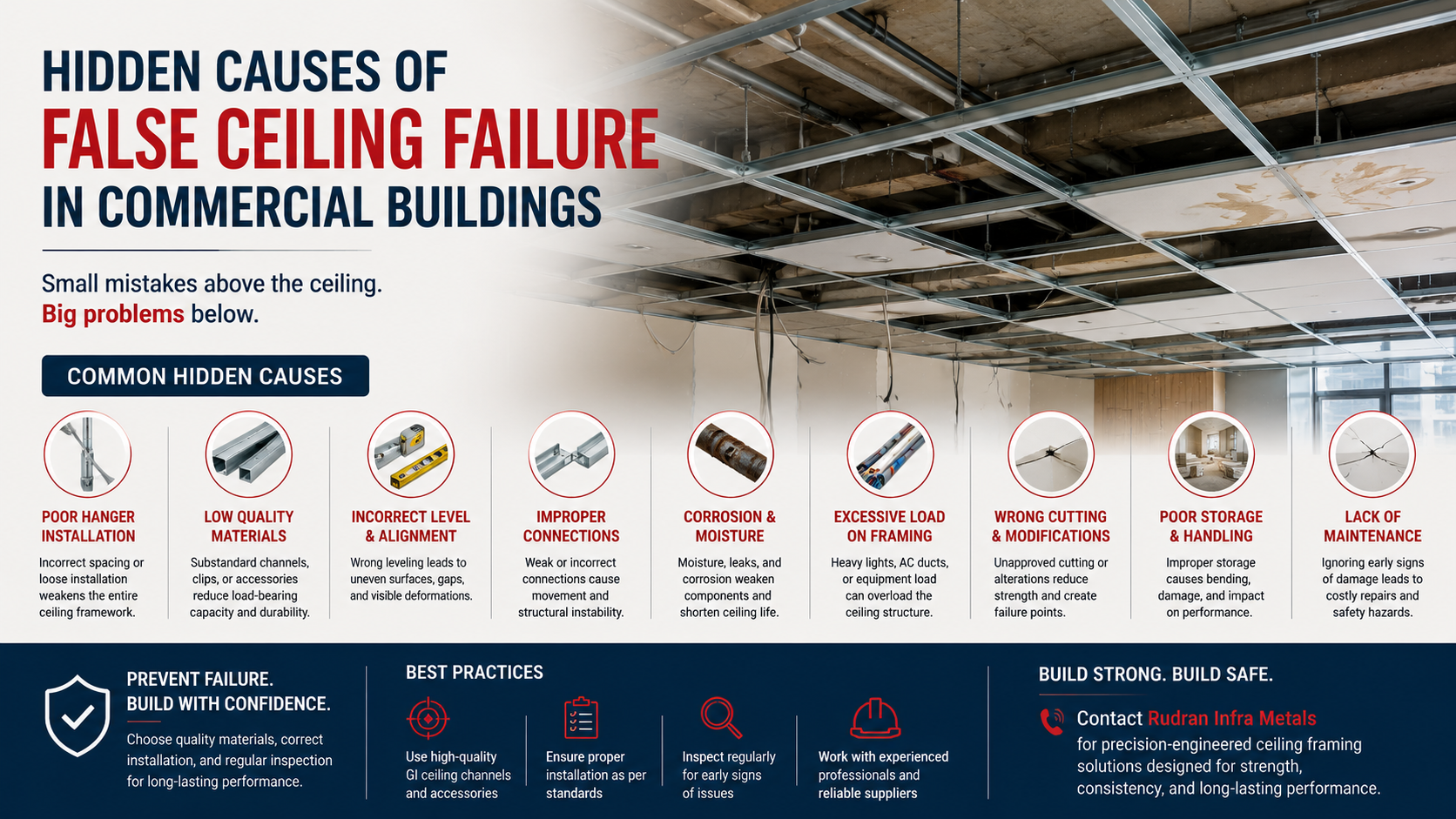
Hidden Causes of False Ceiling Failure in Commercial Buildings
A false ceiling is more than a design feature-it plays an important role in the functionality, safety, and overall performance of a commercial space. It conceals electrical wiring, HVAC ducts, fire protection systems, and lighting while creating a clean, professional interior. However, when a false ceiling begins to sag, crack, or collapse, the consequences can be expensive, disruptive, and even dangerous.
Many people assume ceiling failures happen because of poor-quality ceiling boards, but the real causes are often hidden within the framing system. Weak GI channels, incorrect installation, poor planning, and lack of quality checks are some of the most common reasons behind ceiling failures.
This article highlights the most common reasons false ceilings fail in commercial buildings and shares practical steps to help construction teams reduce the risk of future problems.
Why Do False Ceilings Fail in Commercial Buildings?
False ceilings usually fail because of a combination of poor material selection, incorrect installation practices, excessive loads, and inadequate maintenance. Understanding these hidden issues before installation helps improve safety, durability, and long-term performance.
1. Poor Quality Ceiling Framing
The ceiling framing system acts as the backbone of the entire ceiling. If the GI channels are manufactured with inconsistent dimensions or inferior steel, the framework may lose its stability over time.
Quality framing provides:
- Better structural support
- Accurate alignment
- Improved load distribution
- Long-lasting performance
Choosing high-quality galvanized steel ceiling channels is one of the simplest ways to reduce the risk of future failures.
2. Incorrect Channel Spacing
One of the most overlooked reasons for ceiling failure is improper spacing between ceiling channels.
When channels are placed too far apart:
- Ceiling boards may sag
- Joints may crack
- Vibrations increase
- Load distribution becomes uneven
Always follow the recommended spacing based on the ceiling system and project specifications.
3. Poor Suspension System Installation
The suspension system transfers the ceiling load to the building structure. If Incorrect installation of hangers, suspension rods, or anchors can weaken the support system and affect the stability of the entire ceiling framework.
Common mistakes include:
- Loose anchor fasteners
- Improper hanger spacing
- Bent suspension rods
- Incorrect fixing methods
A properly installed suspension system ensures the ceiling remains secure throughout its service life.
How Does the Surrounding Environment Influence False Ceiling Performance?
Even a well-designed ceiling can experience problems if environmental conditions are ignored.
4. Moisture and Water Leakage
Water is one of the biggest enemies of false ceilings.
Roof leaks, plumbing issues, and condensation can damage ceiling boards while also affecting the steel framework if protective coatings are compromised.
Preventive measures include:
- Fixing roof leaks immediately
- Inspecting plumbing regularly
- Maintaining HVAC systems
- Using galvanized steel framing
5. Overloading the Ceiling
False ceilings are not designed to support unlimited weight.
Heavy lighting fixtures, air-conditioning units, speakers, and decorative elements should never rely solely on ceiling channels unless the system is specifically engineered for those loads.
Heavy equipment should always have independent structural support.
6. Corrosion of Steel Components
Commercial buildings in humid environments may experience corrosion if low-quality or non-galvanized framing materials are used.
Galvanized steel channels help resist corrosion and provide longer service life compared to untreated steel.
Regular inspections also help identify corrosion before it becomes a structural issue.
What Installation Mistakes Lead to Ceiling Failure?
Many failures occur because installation teams overlook basic quality practices.
7. Poor Workmanship
Even premium-quality materials cannot perform well if installation is rushed.
Common workmanship issues include:
- Misaligned channels
- Loose screws
- Uneven framing
- Incorrect board fixing
- Improper joint treatment
Experienced installers should always follow manufacturer guidelines and approved drawings.
8. Unapproved Site Modifications
Cutting or removing ceiling channels after installation weakens the framework.
Contractors sometimes modify framing to accommodate additional ducts or cables without consulting engineers.
These changes can reduce structural stability and create weak points within the ceiling system.
9. Lack of Quality Inspection
Many ceiling problems could be avoided through simple inspections before closing the ceiling.
Builders should verify:
- Channel alignment
- Suspension points
- Fastener quality
- Framing dimensions
- Board fixing
- Service coordination
Early inspections reduce costly repairs after project completion.
How Can Builders Prevent False Ceiling Failures?
Preventing ceiling failures starts long before installation begins.
10. Choose Quality Materials and Trusted Manufacturers
Reliable ceiling systems begin with high-quality GI framing components manufactured with precision and consistency.
When selecting ceiling channels, check for:
- Galvanized steel construction
- Consistent dimensions
- Straight profiles
- Proper thickness
- Reliable manufacturing standards
- Timely delivery
Working with an experienced manufacturer ensures better product quality and project support.
For more information, read our False Ceiling Channel Types Explained and Why Builders Are Switching to Galvanized Steel Ceiling Framing guides.
Conclusion
Most false ceiling failures are not caused by the visible ceiling boards but by hidden problems within the framing system. Poor-quality GI channels, incorrect spacing, inadequate suspension, moisture, corrosion, and poor workmanship can all reduce the lifespan of a commercial ceiling.
By selecting precision-engineered galvanized steel ceiling channels, following proper installation practices, and conducting regular quality inspections, builders can significantly improve the durability and safety of commercial ceiling systems.
Investing in quality materials from the beginning is far more cost-effective than repairing or replacing failed ceilings later.
Looking for high-quality GI false ceiling channels for your next commercial project?
Get in touch to learn more about our galvanized ceiling framing solutions for residential, commercial, and industrial construction projects.
Frequently Asked Questions
1. What is the most common cause of false ceiling failure?
Poor framing quality, incorrect installation, and inadequate support are among the most common causes.
2. Can water leakage damage a false ceiling?
Yes. Moisture can weaken ceiling boards, damage finishes, and contribute to corrosion if left unresolved.
3. Why are galvanized steel ceiling channels preferred?
They provide better corrosion resistance, dimensional stability, and long-term structural performance.
4. How often should commercial false ceilings be inspected?
Regular inspections should be carried out during installation and as part of routine building maintenance.
5. Can heavy lighting fixtures be supported by ceiling channels?
Only if the ceiling system is specifically designed for those loads. Heavy fixtures generally require independent structural support.