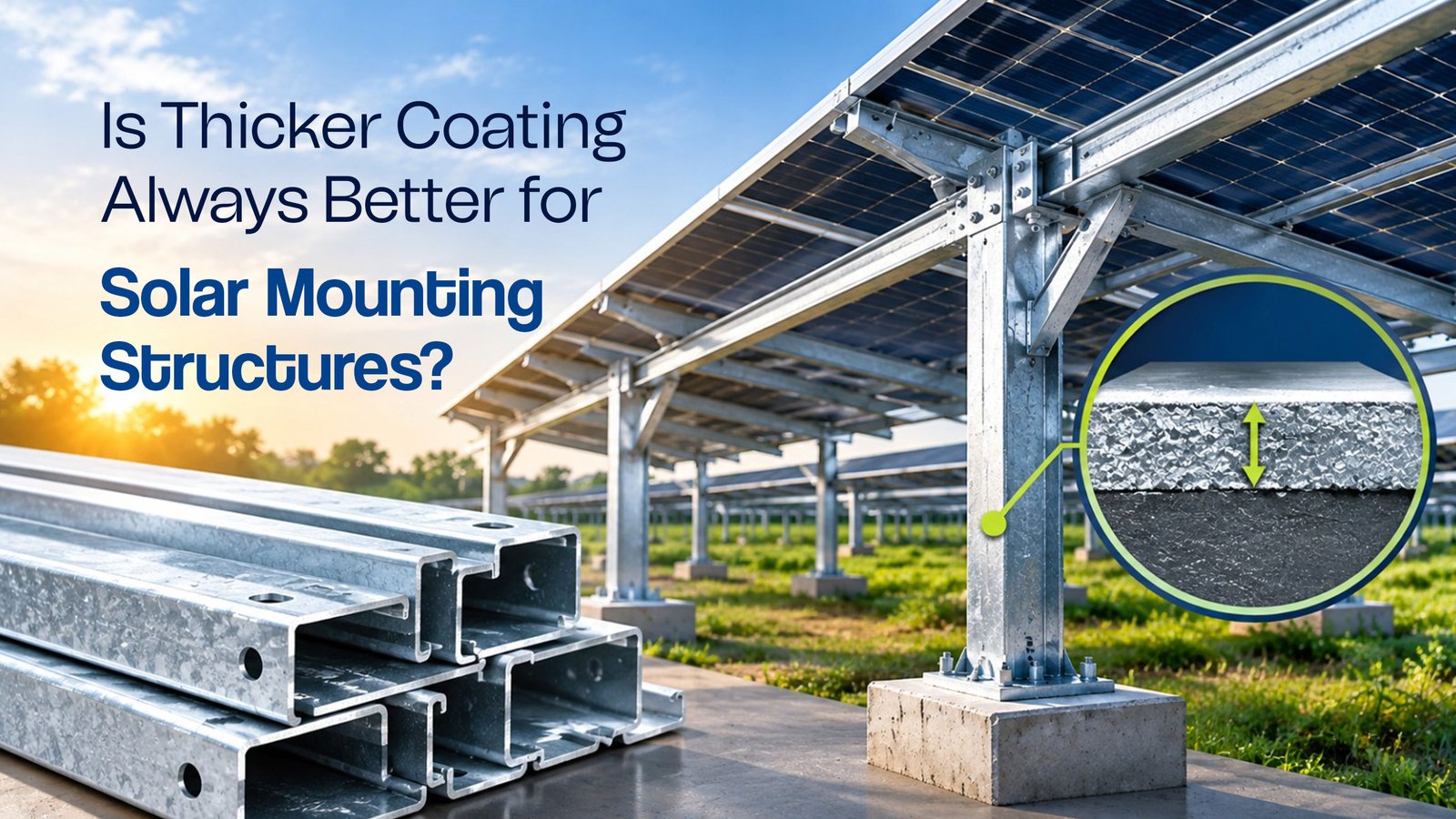
When choosing a solar mounting structure, buyers often compare steel thickness, coating thickness, and material specifications. One common assumption is that a thicker protective coating always provides better corrosion resistance.
But is that really true?
Not necessarily.
Coating thickness is an important factor, but it is not the only factor that determines how well a solar mounting structure performs in outdoor conditions.
The coating type, application process, material quality, site environment, and manufacturing practices also play important roles.
Let’s understand what matters when selecting a corrosion-protection system for solar structures.
1. Why Do Solar Mounting Structures Need Protective Coatings?
Solar mounting structures are installed outdoors and remain exposed to changing weather conditions for many years.
Rain, humidity, moisture, industrial pollution, and coastal salt exposure can gradually affect unprotected steel.
Corrosion may reduce the effective thickness of steel members over time and affect their long-term durability.
Protective coatings create a barrier or provide sacrificial protection that helps reduce corrosion.
Common coating options used in solar structure applications include GI, HDG, and ZAM.
2. Understanding Coating Thickness
Coating thickness refers to the thickness of the protective layer applied to a metal surface.
In galvanised steel, zinc provides corrosion protection by acting as a barrier and offering sacrificial protection to exposed steel.
The coating specification may be expressed in microns (µm) or as coating mass in grams per square metre (g/m²), depending on the product and applicable standard.
However, these measurements are not interchangeable without considering the coating composition and measurement basis.
When comparing materials, buyers should always check the relevant technical specification instead of relying only on a coating number.
3. GI, HDG, and ZAM: Different Coatings, Different Characteristics
GI (Galvanized Iron/Steel)
GI steel generally has a zinc coating applied during the steel production process.
It is widely used in manufactured steel profiles and offers corrosion protection suitable for many applications.
Its performance depends on the coating specification, fabrication process, and environmental exposure.
HDG (Hot-Dip Galvanized Steel)
HDG involves immersing fabricated steel components in molten zinc.
This process creates a zinc coating over the prepared surfaces, including properly processed edges, holes, and welded areas.
The coating thickness depends on the steel characteristics, component geometry, and applicable galvanizing standard.
ZAM (Zinc-Aluminium-Magnesium)
ZAM is a metallic coating that combines zinc, aluminium, and magnesium.
It offers enhanced corrosion resistance in suitable applications and can provide improved protection around cut edges compared with conventional zinc-coated steel.
However, the actual performance depends on the coating grade, coating mass, processing, and environment.
These three options should be compared based on their complete specifications rather than coating thickness alone.
4. Why Thicker Coating Is Not Always the Best Choice
A thicker coating can provide additional corrosion protection in certain situations, but it does not automatically make every structure better.
There are several reasons.
Environmental Conditions Matter
A solar project located near the coast may experience different corrosion conditions compared with an installation in an inland region.
Industrial pollution, humidity, soil contact, and chemical exposure can also influence coating performance.
The coating should be selected according to the actual exposure conditions.
Coating Type Matters
A zinc coating and a zinc-aluminium-magnesium coating have different compositions and corrosion behaviour.
Therefore, comparing them using thickness alone may not provide a fair assessment.
Manufacturing Quality Matters
Poor surface preparation, inconsistent coating application, handling damage, and improper storage can affect coating performance.
A suitable coating specification must be supported by proper manufacturing and inspection procedures.
Fabrication Details Matter
Cutting, drilling, welding, and handling can affect protective coatings.
The selected coating system should be compatible with the manufacturing process and the final component requirements.
5. What Should Buyers Check Before Selecting a Coating?
Before purchasing solar mounting structures, check the following:
- Type of coating: GI, HDG, or ZAM.
- Applicable material and coating standards.
- Specified coating thickness or coating mass.
- Surface preparation and manufacturing process.
- Cut-edge and weld protection requirements.
- Environmental exposure conditions.
- Quality inspection and coating test reports.
For hot-dip galvanizing, applicable standards such as IS 4759 may be relevant depending on the product and specification. For continuously coated steel, the appropriate product standard should be checked separately.
6. Choose the Right Coating for the Right Project
The best coating is not necessarily the thickest one. It is the coating system that provides the required corrosion protection under the project’s actual environmental conditions.
For example, a coating suitable for a standard inland installation may not be the preferred choice for a highly corrosive coastal environment.
Working with an experienced manufacturer and specifying the correct coating requirements can help avoid unnecessary expenses while maintaining suitable protection.
Conclusion
Coating thickness is important, but it should never be the only factor considered when selecting a solar mounting structure.
Coating composition, application method, manufacturing quality, environmental exposure, and applicable standards all influence corrosion performance.
At Rudran Infra Metals, understanding material and coating specifications is an important part of evaluating solar mounting structure requirements.
Remember, the objective is not simply to choose a thicker coating. It is to choose the right protection for the project.