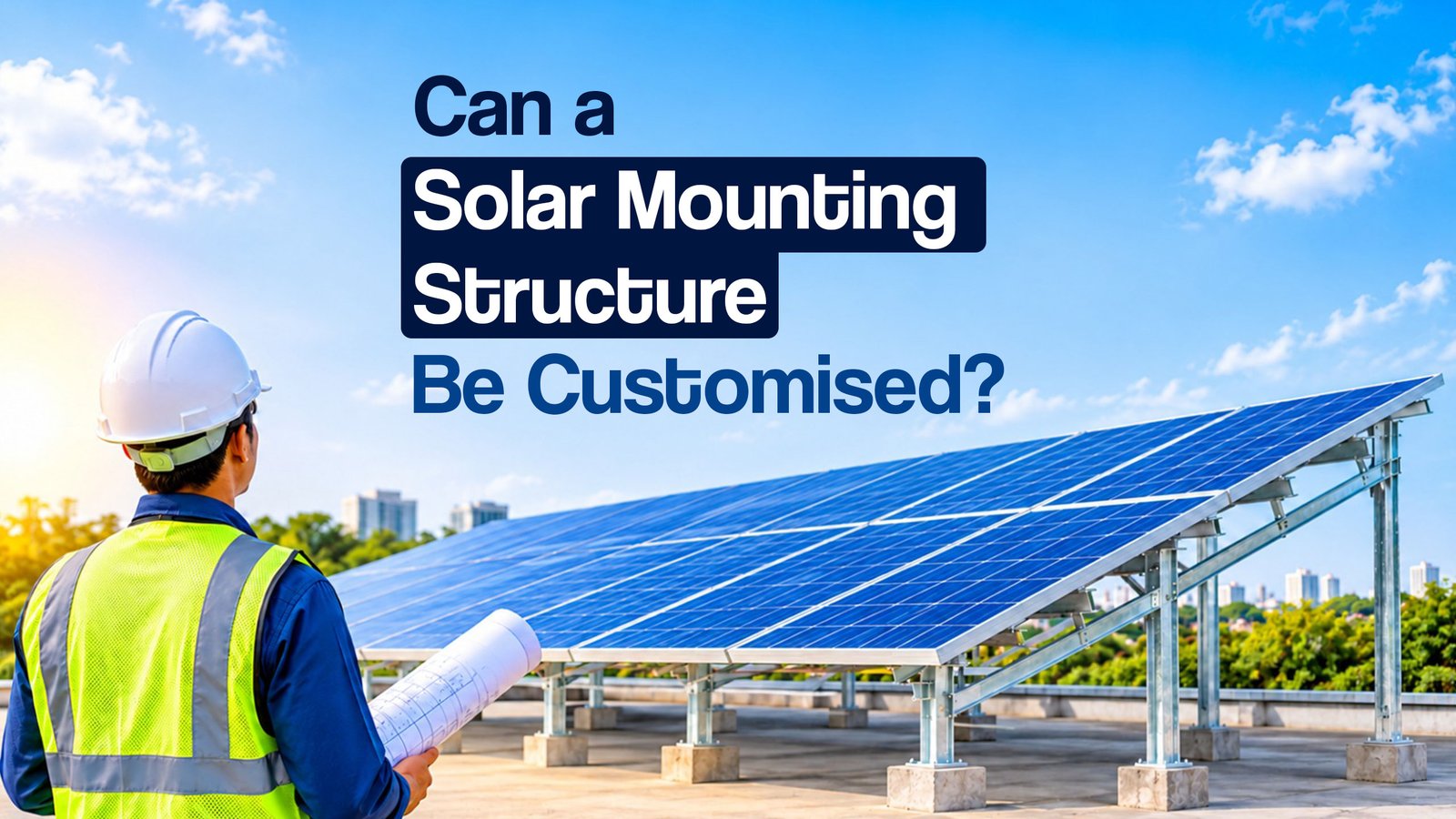
Not every solar project has the same requirements.
Some projects are installed on open land, while others are developed on industrial rooftops, commercial buildings, or sites with unusual layouts. Panel dimensions, roof conditions, installation heights, and foundation requirements can also vary.
So, does every project need to follow a standard solar mounting structure design?
Not necessarily.
Solar mounting structures can be customised according to the technical and site-specific requirements of a project. Customisation helps ensure that the structure fits the installation environment rather than forcing the project to work around a standard design.
Let’s understand how it works.
1. Customisation Based on Site Conditions
Every solar installation site has its own characteristics.
A ground-mounted project may have uneven land, different soil conditions, or specific foundation requirements. A rooftop installation may have limited space, existing structural members, or restrictions on drilling and fixing.
In such situations, a customised mounting structure can be designed to suit the available space and installation conditions.
Before finalising the design, engineers should consider the site survey, roof or ground conditions, structural capacity, and applicable design loads.
2. Customised Structure Dimensions
Standard structural dimensions may not always match the requirements of a particular solar project.
The length of structural members, support spacing, mounting height, and overall configuration may need adjustments.
For example, a project with a specific panel layout may require different purlin lengths or support arrangements.
Customised dimensions help align the structure with the approved engineering drawings and solar panel configuration.
However, every modification should be checked to ensure that the structural performance remains suitable.
3. Different Panel Layouts and Tilt Angles
Solar panels can be installed in different orientations and configurations depending on the available space and project design.
Some projects may require portrait panel arrangements, while others may use landscape configurations.
Tilt angles can also vary depending on the project’s location, energy-generation objectives, spacing requirements, and structural considerations.
A customised mounting structure can be developed to accommodate the approved panel arrangement and tilt angle.
This helps create a more organised installation layout while considering structural loading and maintenance access.
4. Material and Coating Customisation
Material selection is another area where project-specific requirements matter.
Solar mounting structures may use different steel grades, section thicknesses, and corrosion-protection systems.
Common coating options include:
- GI for suitable applications requiring zinc-coated steel.
- HDG for fabricated components requiring hot-dip galvanizing.
- ZAM for applications where its enhanced corrosion-protection characteristics are appropriate.
The selection should depend on environmental exposure, structural specifications, budget, and expected service life.
Customisation does not simply mean selecting a different coating. It means choosing materials that are suitable for the project’s actual conditions.
5. Customisation for Different Applications
Solar mounting structures are used across different types of installations.
Industrial Rooftops: Structures may need to accommodate existing roof profiles, available space, and attachment limitations.
Ground-Mounted Solar Plants: Designs may be customised according to soil conditions, foundation types, terrain, and wind loads.
Commercial Solar Installations: Space optimisation and installation accessibility may influence the structural arrangement.
Specialised Projects: Certain projects may require non-standard dimensions, elevated mounting arrangements, or specific connection details.
Each application requires appropriate engineering evaluation before manufacturing.
6. What Information Is Required for Customisation?
To develop a suitable customised solar structure, manufacturers generally need some basic project information.
This may include:
- Project location.
- Total solar capacity.
- Solar panel dimensions and specifications.
- Approved panel layout.
- Required mounting height and tilt angle.
- Site photographs or layout drawings.
- Soil or rooftop information.
- Design wind speed and other applicable loading requirements.
- Preferred material and coating specifications.
The more accurate the project information, the easier it becomes to develop a suitable manufacturing solution.
7. Why Choose a Manufacturer That Supports Customisation?
A manufacturer with suitable machinery, technical understanding, and production flexibility can help deliver components according to project-specific requirements.
Custom manufacturing also requires proper coordination between design, production, and quality-control teams.
The goal should not be to create unnecessary complexity. It should be to manufacture components that fit the approved design and installation requirements.
Conclusion
Yes, solar mounting structures can be customised. From dimensions and panel layouts to material selection and foundation arrangements, several aspects can be adapted according to project requirements.
The important point is to ensure that every customisation is supported by proper engineering and manufacturing checks.
At Rudran Infra Metals, customised solar mounting structure solutions are an important part of addressing different project requirements.
Different sites. Different layouts. Different requirements. The right structure should be designed to fit the project.