Introduction
UPVC windows and doors are only as strong as the steel reinforcement hidden inside them. While the UPVC profile provides insulation and aesthetics, the galvanized steel reinforcement gives the frame its strength, rigidity, and long-term stability.
Choosing the correct reinforcement profile is critical for fabricators, architects, and project engineers. Different window sizes, wind loads, and hardware configurations require different steel profiles to achieve optimal structural performance.
This guide explains the most common UPVC reinforcement profile types, their dimensions, applications, advantages, and how to choose the right profile for your project.
What Is a UPVC Reinforcement Profile?
A UPVC reinforcement profile is a galvanized steel section inserted inside a UPVC frame or sash to improve strength, prevent deformation, and support hardware such as hinges and locks.
Without steel reinforcement, UPVC profiles may experience:
- Frame bending
- Door sagging
- Lock misalignment
- Poor screw holding
- Reduced lifespan
Proper reinforcement helps windows and doors withstand daily operation and environmental loads.
Why Are Steel Reinforcement Profiles Important?
Steel reinforcement provides structural stability that UPVC alone cannot achieve.
Major benefits include:
- Increased load-bearing capacity
- Better screw retention
- Improved wind resistance
- Reduced frame deformation
- Longer service life
- Better operational performance
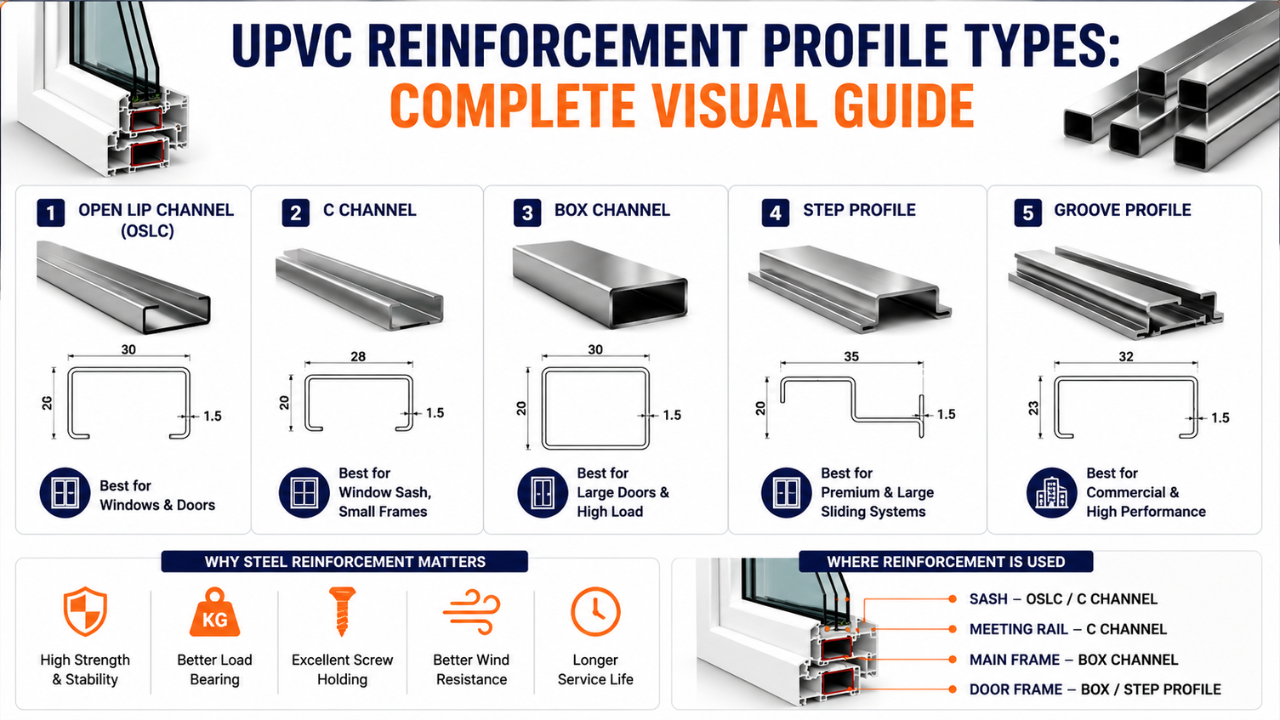
Different Types of UPVC Reinforcement Profiles
1. Open Lip Steel Channel (OSLC)
What Is an OSLC Profile?
OSLC (Open Lip Steel Channel) is one of the most widely used reinforcement profiles in the UPVC industry.
It features an open C-shaped profile with return lips that increase stiffness without adding excessive weight.
Typical Dimensions
| Width | Height | Thickness |
| 25 mm | 20 mm | 1.2 mm |
| 30 mm | 25 mm | 1.5 mm |
| 35 mm | 25 mm | 2.0 mm |
Applications
- Casement windows
- Sliding windows
- Residential doors
- Ventilator frames
Advantages
- Lightweight
- Cost-effective
- Easy fabrication
- Excellent screw holding
- Good torsional strength
2. C Channel Reinforcement
What Is a C Channel?
The C Channel is a fully open structural profile used where moderate reinforcement is required.
Its design allows easy insertion into UPVC profiles while providing adequate rigidity.
Common Applications
- Window sash
- Small door frames
- Sliding sections
- Fixed windows
Benefits
- Easy installation
- Lower material cost
- Good dimensional stability
3. Box Channel
What Is a Box Channel?
Box Channels are closed rectangular reinforcement sections designed for heavy-duty applications.
Compared to open profiles, they provide significantly higher torsional strength.
Typical Applications
- Large doors
- French doors
- Villa windows
- High-rise buildings
- Commercial glazing
Advantages
- Maximum structural rigidity
- Excellent wind resistance
- Better hardware support
- Reduced frame twisting
4. Step Reinforcement Profile
What Is a Step Profile?
Step profiles feature multiple bends that improve structural strength while fitting specialized UPVC chambers.
Best Used For
- Premium window systems
- Large sliding doors
- Heavy glazing
- Multi-track systems
Benefits
- Increased stiffness
- Better load distribution
- Optimized weight
5. Groove Reinforcement Profile
What Is a Groove Profile?
Groove profiles include formed grooves that increase rigidity without substantially increasing material consumption.
Common Uses
- Premium residential windows
- Commercial window systems
- High-performance doors
Advantages
- Higher bending strength
- Better profile engagement
- Enhanced structural performance
Comparison Table
| Profile | Strength | Weight | Cost | Best Application |
| OSLC | ★★★★☆ | Medium | Low | Residential Windows |
| C Channel | ★★★☆☆ | Low | Low | Small Frames |
| Box Channel | ★★★★★ | High | Medium | Large Doors |
| Step Profile | ★★★★☆ | Medium | Medium | Premium Systems |
| Groove Profile | ★★★★☆ | Medium | Medium | Commercial Projects |
How Do You Choose the Right Reinforcement Profile?
The correct profile depends on several engineering factors.
Consider:
- Window size
- Door dimensions
- Wind load
- Glass weight
- Hardware type
- Building height
- Profile series
- Customer requirements
Never choose reinforcement based solely on price.
What Thickness Should You Select?
Generally,
- 1.0-1.2 mm – Small residential windows
- 1.2-1.5 mm – Standard doors and windows
- 1.8-2.0 mm – Large commercial projects
- 2.0 mm+ – Heavy-duty applications
The final selection should always match the UPVC system design and structural requirements.
Why Does Galvanization Matter?
The zinc coating protects reinforcement profiles from corrosion inside the UPVC frame.
Quality galvanization offers:
- Longer lifespan
- Better corrosion resistance
- Improved appearance
- Lower maintenance
- Consistent structural performance
Common Mistakes When Selecting Reinforcement
Avoid these mistakes:
- Choosing the wrong profile size
- Ignoring steel thickness
- Using poor-quality galvanization
- Selecting low-grade steel
- Ignoring wind load requirements
- Using generic reinforcement for all projects
Why Choose Rudran Infra Metals?
Rudran Infra Metals manufactures precision-engineered galvanized steel reinforcement profiles for the UPVC industry.
Our capabilities include:
- Precision cold roll forming
- High-quality galvanized steel
- Consistent dimensional accuracy
- Multiple profile options
- Strict quality inspection
- Reliable production capacity
- Custom profile development
Conclusion
Selecting the correct UPVC reinforcement profile is essential for producing durable, high-performance windows and doors. Whether you’re manufacturing residential casement windows or heavy-duty commercial systems, understanding the differences between OSLC, C Channel, Box Channel, Step Profile, and Groove Profile helps ensure better structural integrity, improved hardware support, and longer product life. Investing in the right reinforcement profile today reduces maintenance, enhances safety, and improves customer satisfaction for years to come.
Contact us today for product information, technical support, or a custom quotation. Our team is ready to help you find the right solution for your project.
FAQs
Which UPVC reinforcement profile is most commonly used?
OSLC profiles are among the most widely used because they balance strength, weight, and cost for residential applications.
What is the difference between a Box Channel and an OSLC profile?
Box Channels provide greater torsional strength for large openings, while OSLC profiles are more economical for standard windows and doors.
What thickness is recommended for UPVC reinforcement?
The required thickness depends on the window size, wind load, and hardware. Most applications use steel between 1.2 mm and 2.0 mm.
Why is galvanized steel used inside UPVC profiles?
Galvanized steel improves corrosion resistance and extends the service life of windows and doors exposed to varying weather conditions.
Can one reinforcement profile be used for every UPVC system?
No. Different UPVC systems require specific reinforcement shapes and dimensions to ensure proper fit and structural performance.